Meeting Texas Playground Safety Standards
Municipal parks departments, school districts, and property managers across Texas are fielding more bids than ever from newer, smaller surfacing outfits promising a lower price tag. What often goes unmentioned is whether that price includes the testing and certification your project actually needs. Skip that step, and the difference doesn't surface during the bid review, it surfaces during inspection, or worse, after an incident. Here's what that looks like for your next project.
Texas Compliance Standards
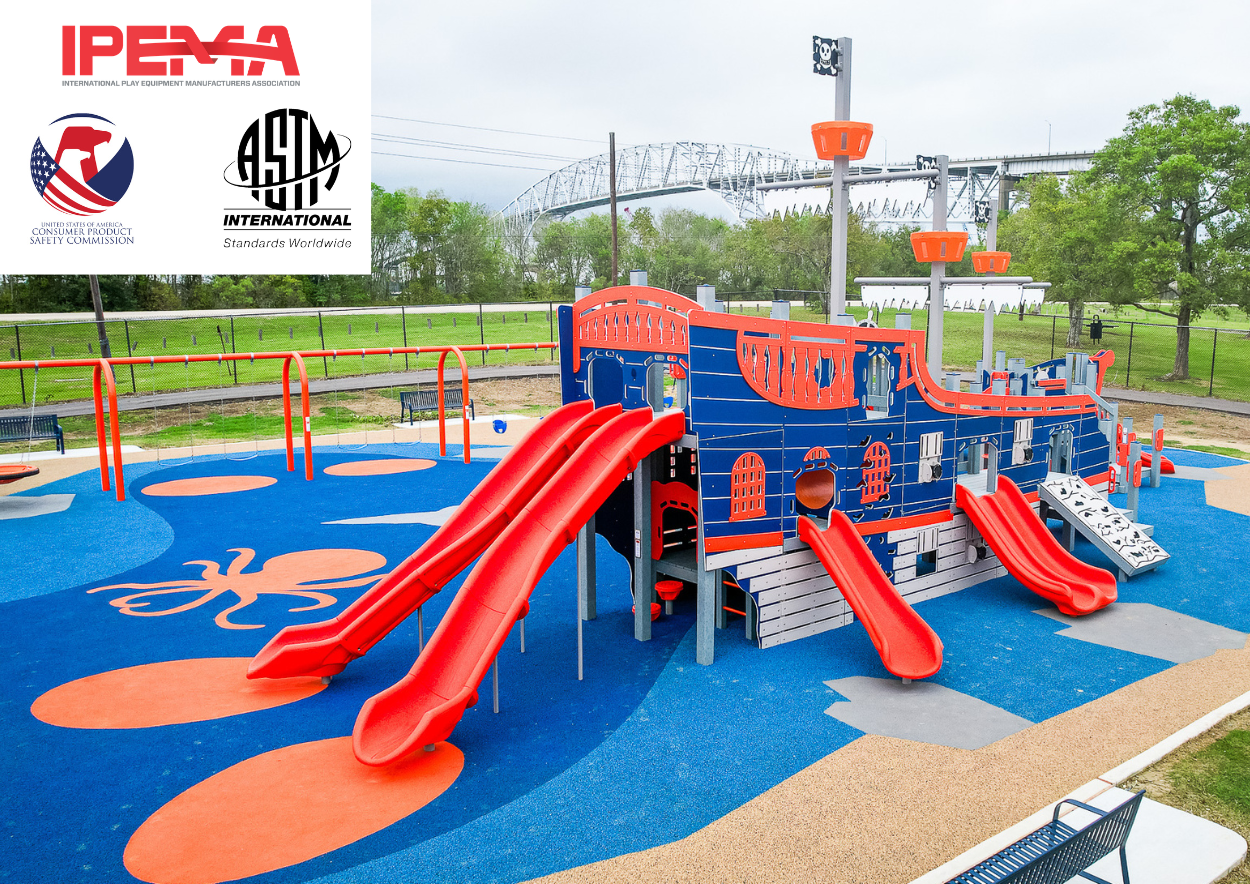
Unlike some states, there's no single Texas law that names a required certification for every playground surface. What does apply: Texas Administrative Code Title 26, Chapter 746, Subchapter U, which sets shock-absorption requirements for surfacing in licensed child-care facilities. Outside of child care, schools, parks, and municipalities are typically judged against ASTM F1292 and the CPSC Public Playground Safety Handbook, the national benchmarks courts and insurers point to when determining whether a facility exercised reasonable care.
The absence of one blanket statute doesn't lower the stakes, it just moves them. Licensed child-care operations found with a deficiency can face administrative penalties, and in more serious cases, license suspension or revocation. Everyone else is exposed differently, through a liability claim that turns on whether the surfacing met the industry standard IPEMA certification and ASTM testing are built to satisfy.
Put simply, no Texas statute forces every facility to install certified surfacing. But without it, you're the one left explaining why you didn't.
The Hidden Cost of a Low Bid
Skipping certification testing doesn't make a bid cheaper, it makes it unverified. Unverified surfacing tends to cost you later, not now: a failed inspection that pushes back your opening date, the expense of ripping out and redoing surfacing that never met spec, and a possible coverage gap if an injury claim ever points back to the material itself. Whatever you saved on the invoice has a way of showing up again, usually with interest.
Robertson Recreational Surfaces holds every project to ASTM and IPEMA certification standards, full stop. That standard doesn't stop at the surface either: it shapes how we support you, how we install, and how we maintain your surfacing long after the job is finished.
Robertson vs. Other Brands
Poured rubber or engineered wood fiber, the expectation in Texas is the same: surfacing that's been independently verified, not just assumed safe because it looks the part. The gap between Robertson and uncertified brands rarely shows up on installation day. It shows up months or years later, when something's tested for the first time.
| |
Robertson (IPEMA/ASTM) |
Other Brands |
| Tested to ASTM F1292 (impact attenuation) |
Independently verified |
Rarely tested |
|
Meets ADA accessibility (ASTM F1951)
|
Yes |
Often unverified |
| Documentation provided |
Full test reports and certificates |
Typically none |
Installers manufacturer-trained & certified
|
Yes, certified installers training program
|
Often no formal installer training
|
Skipping the testing step doesn't lower your risk. It just delays when you find out about it.

%20TILE_lowres.jpg?width=3000&name=PARK%20AVE%20ELEM_WEBSTER%20MA%20(3)%20TILE_lowres.jpg)
.jpg?width=1280&height=853&name=RRS_Southern%20Gateway%20Park_Dallas%2c%20TX_2026%20(69).jpg "RRS_Southern Gateway Park_Dallas, TX_2026 (69)")
-1.jpg?width=1280&height=853&name=RRS_Southern%20Gateway%20Park_Dallas%2c%20TX_2026%20(69)-1.jpg)
.jpg?width=1280&height=854&name=RRS_Fun%20Island%2c%20Port%20Arthur%20TX_2023%20(3).jpg)
.jpg?width=1600&height=900&name=RRS_McMullen%20Park%2c%20TX_2025%20(1).jpg)