
.jpg)
When you're designing a playground, the surface beneath the equipment matters just as much as the equipment itself. Falls account for over 75% of all playground-related injuries, according to the Centers for Disease Control and Prevention. Impact attenuation is the property that determines whether your surfacing can absorb the force of a fall and protect children from life-threatening injuries. Robertson Recreational helps landscape architects and parks professionals select safety surfacing that meets all required standards while creating inclusive play environments.
This article breaks down what impact attenuation means, how it's measured, and what you need to know to stay compliant with ASTM and ADA requirements.
Key Takeaways: What Is Impact Attenuation in Playground Surfacing
- Impact attenuation measures how well a playground surface absorbs energy and cushions falls to reduce injury risk.
- ASTM F1292 is the industry standard that tests surfacing for G-max and Head Injury Criterion (HIC) values.
- To pass testing, surfaces must have a G-max below 200 and an HIC below 1,000 at the designated fall height.
- Robertson Recreational offers poured rubber, bonded rubber, tiles, and synthetic turf surfacing that meets ASTM and ADA requirements.
- Accessibility standards under ASTM F1951 work alongside impact attenuation requirements to ensure safer, inclusive playgrounds.
What Is Impact Attenuation?
Impact attenuation refers to a surface's ability to absorb energy when something or someone falls onto it. In playground applications, this means the surfacing material reduces the force transmitted to a child's body during a fall. The goal is to lower the risk of severe injuries, particularly head trauma.
Think of it this way: concrete transmits nearly all the energy of a fall directly to the body. A properly installed safety surface disperses that energy over a longer time period, dramatically reducing peak forces. This is why hard surfaces like asphalt and concrete are never acceptable beneath playground equipment.
How Is Impact Attenuation Measured Under ASTM F1292?
The ASTM F1292 standard establishes the test procedure for measuring impact attenuation in playground surfacing. Testing involves dropping an instrumented metal headform (mimicking the shape of a child's head) onto the surface from various heights. Two measurements determine whether the surface passes.
G-max measures the maximum deceleration of the headform at impact. A value exceeding 200 indicates the surface cannot adequately protect against life-threatening head injuries. The Head Injury Criterion (HIC) evaluates the potential for head injury based on the acceleration-time history of the impact. An HIC value above 1,000 indicates unacceptable injury risk.
For a surface to comply, both the G-max must stay at or below 200 and the HIC must remain at or below 1,000 when tested at the critical fall height.
What Is Critical Fall Height?
Critical fall height is the maximum height from which a fall onto the surface would still produce G-max and HIC values within acceptable limits. Every playground surfacing material has a critical fall height rating determined through laboratory testing at three temperatures (cold, ambient, and hot) to simulate real-world conditions.
Your surface's critical fall height must exceed the fall height of the highest piece of equipment in your playground. If you have a climbing structure with a platform at 8 feet, your surfacing must be rated for at least 8-foot falls. This is non-negotiable for both safety and compliance.
Why Temperature Testing Matters
Rubber and other materials change properties with temperature. A surface that performs well at 70°F might harden in freezing weather or soften excessively in summer heat. ASTM F1292 requires testing at 25°F, ambient temperature, and elevated temperatures to confirm year-round protection.
How Impact Attenuation Connects to ADA Compliance
The 2010 ADA Standards for Accessible Design require playground surfaces to meet both impact attenuation and accessibility requirements. A surface that cushions falls but cannot support wheelchair travel fails to meet the complete standard. Robertson's accessibility resources walk through these requirements in more detail.
ASTM F1951 tests the firmness and stability of playground surfaces by measuring the work force required for a wheelchair user to travel across the material. Loose-fill surfaces like engineered wood fiber can meet impact requirements but often struggle with accessibility. Unitary surfaces like Robertson Recreational's poured rubber surfacing typically perform well on both tests when properly installed.
What the Standards Require for Accessible Routes
Within the play area, accessible routes must maintain a running slope no steeper than 1:16 (6.25%) and a cross slope no steeper than 1:48 (2.08%). Openings in the surface cannot exceed half an inch, and changes in level above a quarter inch must be beveled. These requirements apply to the path connecting all accessible play components.
Which Surfacing Materials Meet Impact Attenuation Standards?
Playground surfaces fall into two broad categories: loose-fill materials and unitary surfaces. Both can meet ASTM F1292 requirements, but they have different characteristics that affect installation, maintenance, and accessibility.
Loose-Fill Materials
Engineered wood fiber, rubber mulch, sand, and pea gravel are common loose-fill options. Engineered wood fiber (EWF) meeting ASTM F2075 specifications offers good impact attenuation at proper depths. However, loose materials displace under heavy use, particularly under swings and at slide exits. This displacement creates accessibility issues and can reduce the surface's protective capacity.
Unitary Surfaces
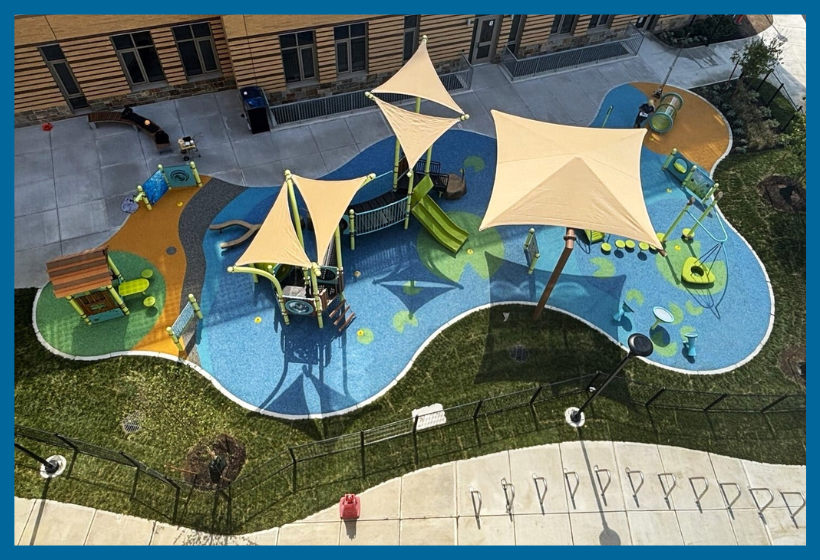
Poured rubber, rubber tiles, and synthetic turf systems offer more consistent performance because they do not shift or compact like loose fills. Robertson Recreational's poured rubber surfacing meets both ASTM F1292 for impact attenuation and ADA accessibility standards. The material is installed in layers—a cushion base for shock absorption and a durable top layer—and can be customized to meet specific critical fall height requirements.
How Often Should Playground Surfaces Be Tested?
ASTM standards and Consumer Product Safety Commission (CPSC) guidelines recommend testing playground surfaces at least annually. High-traffic locations like school playgrounds, municipal parks, and childcare facilities may need more frequent testing.
You should also test after significant weather events, after adding or removing equipment, or whenever visible deterioration appears. For loose-fill materials, regular depth checks and maintenance between formal tests help maintain compliance. Unitary surfaces should be inspected for cracking, seam separation, and surface hardening, and can benefit from scheduled maintenance service to stay ahead of wear.
The International Play Equipment Manufacturers Association (IPEMA) offers third-party certification for surfacing products that meet ASTM standards. Specifying IPEMA-certified materials gives you documented assurance of laboratory compliance. Robertson's testing and compliance resources outline what documentation to look for.
What Happens If a Surface Fails Testing?
When a surface fails ASTM F1292 testing (G-max exceeds 200 or HIC exceeds 1,000), it no longer protects children adequately. The CPSC Public Playground Safety Handbook recommends taking the play equipment out of service until the surface is brought into compliance.
Failure carries liability implications. If a child is injured on equipment above a non-compliant surface, the lack of a current compliance record complicates insurance claims and legal exposure. Documentation of regular testing and maintenance creates a defensible record that demonstrates your commitment to safety.
How Robertson Recreational Supports Safer Playground Design
Robertson Recreational offers a range of safety surfacing products designed to meet ASTM F1292 impact attenuation requirements while supporting accessibility. Poured rubber systems give you precise control over critical fall height and create continuous, accessible routes throughout the play area.
Bonded rubber uses larger pieces in a porous, single-layer system that drains quickly and requires minimal maintenance. Rubber tiles allow modular installation and straightforward repairs. TotTurf synthetic turf installed over a compliant cushion layer combines the look of grass with the safety performance of engineered surfaces.
Each option comes with laboratory test documentation and installation guidance to help you achieve and maintain compliance throughout the playground's service life.
In Conclusion: Making Informed Decisions About Playground Surfacing Safety
Impact attenuation is the foundation of playground safety surfacing. Understanding what ASTM F1292 measures, how critical fall height works, and where accessibility requirements intersect helps you make better decisions during planning and installation.
Choose surfacing rated for your equipment's fall height, verify IPEMA certification or equivalent laboratory documentation, plan for ongoing testing and maintenance, and work with experienced installers who understand both safety and accessibility requirements. The surface beneath your playground equipment protects children every day it's in use.
Not sure which surface is right for your project? Try Robertson's Surface Selector or request a quote to talk through fall height requirements, budget, and maintenance capacity.
FAQs About Impact Attenuation in Playground Surfacing
What does impact attenuation mean in playground surfacing?
Impact attenuation describes how well a surface absorbs energy and reduces the forces transferred to a child's body during a fall. Higher attenuation means better protection against injuries. Robertson Recreational's poured rubber and bonded rubber surfaces are engineered to meet ASTM F1292 impact requirements at rated fall heights.
What is the ASTM F1292 standard?
ASTM F1292 is the standard specification for impact attenuation testing of playground surfacing materials. It establishes pass/fail thresholds of G-max ≤ 200 and HIC ≤ 1,000 through headform drop tests. Surfaces must pass at the designated critical fall height to be considered compliant.
How do I know what critical fall height my playground needs?
Your surfacing's critical fall height must exceed the fall height of your tallest equipment. Measure from the highest accessible platform or standing surface to the ground. Robertson Recreational can help you match surfacing specifications to your equipment layout during the planning phase.
Is impact attenuation the same as ADA accessibility?
No, they are separate requirements that work together. Impact attenuation (ASTM F1292) protects against fall injuries. Accessibility (ASTM F1951) ensures surfaces are firm and stable enough for wheelchair users. Compliant playgrounds need surfacing that meets both standards.
How often should playground surfaces be tested for impact attenuation?
Test annually at minimum, with more frequent testing for high-traffic areas. Robertson Recreational recommends scheduling tests after severe weather, after equipment changes, or whenever surface deterioration becomes visible. Document all test results to maintain compliance records.
Can loose-fill materials like wood chips meet ASTM F1292?
Engineered wood fiber meeting ASTM F2075 specifications can achieve compliance at adequate depths. However, loose materials displace under use, requiring frequent maintenance to maintain both impact attenuation and accessibility. Unitary surfaces typically offer more consistent long-term performance.

.jpg)
%20edit.jpg)